In 2026, it’s difficult for me to write anything positive about WWE. It is not now, nor has ever really been my preferred “style” of pro wrestling presentation, and the fact that Vince and company did their best to monopolize and drive out anything other than their own distorted vision of what pro wrestling should be, it’s hard to feel any love for this company. That’s before we delve into the horrifying and despicable crimes of Vince McMahon. Today, I try to avoid anything the company does, which is easier and easier with their cozy relationship with the fascist administration in the White House and the Kingdom of Saudi Arabia (where journalists are dismembered). Truthfully, it’s hard to go back and watch things I did like when I was keeping up with the company, knowing that everything that came on screen was filtered through the lens of a man who, at the very least, needed serious therapy, and at the most deserves lethal injection. Unfortunately, due to the way the wrestling business went, a lot of my memories are tied to them, if not directly then at least tangentially.
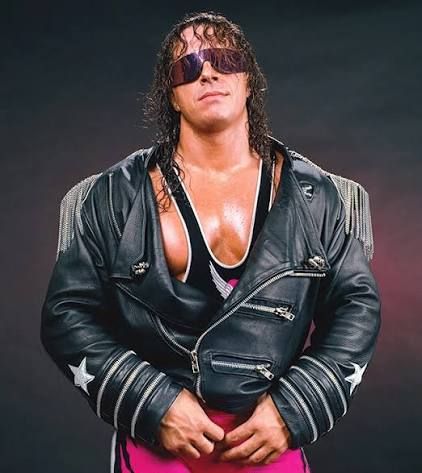
I was never a WWF kid. I grew up in South Carolina, too young to see the peak of Jim Crockett Promotions, but just old enough to see almost all of WCW after they switched from using the NWA name. I discovered the WWF when Ric Flair left in 1991 and showed up in “New York.” As a 5-year-old, I was just happy there was more wrestling, even if it wasn’t the guys I was used to. As Flair found his footing in the WWF, I began to notice guys, and surely, favorites started to form. Obviously, Hulk Hogan was a big deal still, and I liked him a lot. Ultimate Warrior was also cool, but there was a guy who wrestled differently than the big stars. He did more moves, holds, and submissions that made the punches and kicks of the steroid filled giants seem silly. He wrestled with an air of confidence, dressed in pink and black, and he wasn’t even fighting for the world title (yet). He was the Intercontinental Champion, Bret ‘The Hitman’ Hart.
Bret immediately struck me when I first picked up the WWF, my first memories being him and The Mountie feuding over the IC title, and then him being the centrepiece of SummerSlam ’92 against his brother-in-law Davey Boy Smith, in front of Smith’s hometown crowd of over 80,000 at Wembley Stadium in England. By the end of the year, Bret was the World Champion, and while he wasn’t quite a hero on the level of Sting in my eyes, he was more than enough to be my #1 WWF guy. It didn’t hurt that his finishing submission hold, called the Sharpshooter here, was the same Scorpion Death Lock that Sting also used.
Bret wasn’t the first “great wrestler” I ever saw, but something about the way he wrestled captivated me. I was quickly becoming more and more appreciative of the guys who could do a variety of different things in the ring, rather than just punches, kicks, and slams. The commentators would play up his technical prowess, and before I could accurately place Russia on a map, I knew what a Russian leg sweep looked like. My habits as a fan were changing and growing as rapidly as I was, and I began to be a bit more selective with what I liked. All of a sudden, being a “good guy” didn’t mean I loved you, and when Shawn Michaels bounded around the ring, I had to admit that it was cool, even if I didn’t like how he acted.
WrestleMania IX was the event that truly crystallized it for me. After a grueling bout with Yokozuna (a large Samoan man portraying a Japanese sumo wrestler), Bret had been defeated and was no longer the champion. But out of nowhere, Hulk Hogan appeared after the match and immediately slammed and pinned Yoko to win the belt. Where I should have felt elation over the biggest star in the company coming out to save the day, I was underwhelmed and annoyed that if a good guy was gonna hold the belt, it should be Bret.
In my six-year-old mind, that was the day I “smartened up” to what wrestling was. It wasn’t about being the best wrestler at all, if Bret wasn’t the champ. It was also an important early lesson that being the best at something doesn’t necessarily mean that you will always be the one who gets the accolades and appreciation for it. Whether you’re the best wrestler in the wrestling company, or the kid who got the best score on the test, sometimes it’s more about attitude than aptitude.
Bret would be my WWF avatar throughout his time there, and in 1994 I got to go to my first “big” wrestling show. WCW had run our town’s high school football stadium a couple years prior, but it was outside with a few hundred people. This would be with a few thousand other fans at the Florence Civic Center, about an hour and a half away from my hometown of Myrtle Beach. Bret would be there, and I would get to see him wrestle! What was even cooler was that I would get to see him have an actual, competitive match. This was a taping of several episodes of the syndicated Wrestling Challenge show, which would consist of short squash matches where an established star would show off and make short work of some schlub whose only job was to get beaten from pillar to post and make his opponent look good.
Bret, however, was going to be in one of the “dark” matches put on in front of the fans to keep them there through the long stretches of boring wrestling. Bret and his little brother Owen had been teaming together, and they would be taking on my favorite tag team as a young kid, The Steiner Brothers. The Steiners had just arrived in the WWF after making their name in WCW, on the back of Scott Steiner’s freakish strength and agility, and brother Rick’s impressive amateur skill set. These two made even those uncompetitive “squash” matches entertaining to watch by way of their sheer brutality. Two sets of brothers at the top of their game, giving it all in the ring, and putting on one of the best matches I’ve ever seen live, still to this day, 30-plus years and over 60 live shows later. This was everything I loved about pro wrestling, even if I was too young to truly understand and appreciate it.
Just a couple weeks later, at the Royal Rumble, Owen would turn on Bret, setting off their feud against each other and capturing my attention. Through the spring and summer of ’94, I think I was more interested in the WWF than anything else. This did happen to coincide with Hulk Hogan coming to WCW, and I knew that with him there, Sting (my favorite) would probably be stuck behind him in the pecking order when it came to who was the champion. Bret had won the Royal Rumble and the World Championship, and the matches with Owen were some of the most exciting and fun wrestling I had ever seen.
While I had seen great wrestlers and great matches before, Bret was when I started to pay closer attention to things like the structure of matches, the way holds and moves were applied, the way the guys acted in the ring, and the suspense that can be had when you play with an established formula. Bret taught me to appreciate the nuts and bolts of a wrestling match like nobody before him, and helped to create the kid who would obsess over the minutiae of the genre.
As the years wore on, Bret would remain my guy, and when he had his match against “Stone Cold” Steve Austin at WrestleMania 13 in 1997, I was firmly in his corner. Austin wasn’t quite the biggest star in the world yet, and this would be the feud that cemented his place in the main event scene of the WWF, a couple years before the famed “Attitude Era” would make his name as famous as Jerry Springer, Fred Durst, or Tony Hawk in the late ’90s and early ’00s. This match was famous not only for its excellence (on most days I would say this is the best match the company ever produced), but for the “double turn” during the match.
Bret had gone into the match as the face, the vaunted champion who fought for what’s right and was trying to keep the WWF from descending into madness. Austin was the foul-mouthed redneck who chugged beers and preferred fists and stomps to flashy moves and interesting transitions. During the climax of the match, Bret had Austin locked in the sharpshooter. Austin, bloody and battered, refused to submit. He passed out instead of tapping. The bell rang, but Bret didn’t release the hold. He kept the assault going until guest referee Ken Shamrock finally pried him off (one of the first big stars of the very young UFC).
By 1997, I was online, reading wrestling websites, and fully aware of the business behind the curtain. I knew exactly what I was watching, but I still sided with Bret. He was right. He was right about Austin, and he was right about the way the WWF was headed. This was the start of the WWF turning into something I had less and less desire to watch, and once the WWF was the most popular thing amongst adolescent boys, I was pretty disillusioned with the company as a whole.
I wanted Pro Wrestlers who were good at Pro Wrestling and put on exciting, and fun matches, but wrestling was slipping deeper into the sleazy sex and over the top storylines that would draw fans, but turned me off big time. Bret was the last gasp of sanity and reality in the WWF, and once he was gone it would be years before I truly cared about anything the company would do again, even if I kept watching the product.
Bret’s most infamous moment came at the 1997 Survivor Series in Montreal. He was locked in a submission move, his own sharpshooter, against Shawn Michaels for the WWF Championship when the bell rang without him giving up. He was screwed.
Despite having creative control in his contract and an agreed-upon finish, the boss made a call behind his back and changed the outcome. Bret was about to leave for WCW, but he would not lose in Canada, where he was a national hero. In his homeland, he was a proud babyface; in the United States, a hated heel.
He had tried to handle things the right way. He had offered to do business properly. But the leader of the company chose to double-cross him live on pay-per-view. This was bigger than any storyline, bigger than kayfabe. It was real—a legitimate double cross in a world that once thrived on them, but hadn’t seen one like this in years.
This show happened on my 11th birthday, and thanks to a cable descrambler box (I hope the statute of limitations is up on that) I got to watch the show live with my Stepdad. He was convinced it was a work (storyline) so I went to bed disappointed but assuming it was all on the level. Once the news started filtering out into the chatrooms and newsgroups of the day however, we realized that we had actually been witness to history. This was a moment no wrestling fan at the time would ever forget.
Vince parlayed the Montreal screwjob into the company’s top heel spot, embracing every horrible quality he showed in real life. Bret, meanwhile, floundered in the chaos of the dying WCW. It felt so wrong. This guy had worked his ass off for years to reach the top. He had signed a 20-year deal the WWF no longer wanted to honor. They let him go, but still had to stick it to him.
I was too young to have a job, but I never forgot what Vince did to Bret. I resolved never to give myself fully to an organization without something tangible in return. Bret was screwed, plain and simple. At the time, we thought Vince was just a ruthless capitalist. Today we know his crimes run far deeper, but that was the moment I realized he was truly the personification of everything I never wanted to be.
He got to exploit and discard Bret Hart while making more money than ever by playing up the worst parts of himself. Bret, meanwhile, would get kicked in the head in 2000, suffering a career-ending concussion. The workers take the punishment. The bosses get richer for being their worst selves. This was the unfair world of pro wrestling, and as I quickly realized, most of corporate America.
In 2005, under the threat of being smeared in a DVD documentary, Bret returned to the WWF (now WWE). He participated in a retrospective documentary that finally did justice to his career, and he was inducted into the Hall of Fame.
The DVD came out my freshman year of college. That year was hard. I had come to school hoping to make great memories, meet new people, and expand my horizons. Instead, I developed severe anxiety, gained 60 pounds, and blacked out my windows so that even midday felt like night. To say that I was depressed would be an understatement. That DVD, along with the ECW doc, One Night Stand show and the first few seasons of The Simpsons, became my closest companions. Without them, I shudder to think where I might have gone at the height of my depression.
Watching those old matches, reliving the nostalgia, kept me from going to an even darker place. At 19, Bret was doing for me what he had done at 9. He gave me hope. He made me care. He made me pay attention. He kept me going when I didn’t want to.
The DVD wasn’t just nostalgia,it was a lifeline. Seeing him persevere, seeing the joy and craft in his work, reminded me that dedication and integrity mattered, even if the world didn’t always reward it. It was proof that passion could survive exploitation, disappointment, betrayal, and still inspire.
It was also the early days of YouTube, and soon I had access to plenty of old matches featuring Bret, and all my other favorites. I dove deep, discovering old rivalries,moves, and promos. It was like rediscovering a part of myself I had almost lost.
I even got to watch the incredible Wrestling with Shadows documentary again, filmed during the Montreal Screwjob. I had seen it once, years earlier, on A&E, but now it felt different. Paired with the DVD, it became more than a behind-the-scenes story, it was a companion piece, a meditation on resilience, betrayal, and what it means to hold onto your integrity in a corrupt world.
Through those long nights, as I sat alone in my darkened dorm room, Bret was more than a wrestler. He was a guide. A reminder that even when life doesn’t go the way you planned, there’s value in striving, in resisting, and in finding your own moral compass.
Bret eventually made peace with WWE. He participated in several documentaries about his era and time at the top. This journey culminated in a “return” and a WrestleMania match against Vince himself. On paper, it should have been a perfect story: a man finding redemption against the sigil of everything that had hurt him. Instead, it felt like a zany caper. Old men who could barely move, going through the motions, their bodies no longer able to tell the stories they once had. Having to be covered up by an endless parade of distractions, run ins, and fireworks. The classic WWE style that never really grabbed me, and I had now grown to despise
All of this came after everything Vince had done to him. After the Montreal Screwjob. After years of being exploited, betrayed, and discarded. After the brutal grind of the wrestling business itself. After the career-ending concussion that took him out of the ring for good. (That one we can blame on Goldberg, lord knows Bret will)
Bret continued to allow himself to be trotted out for special occasions. Each time, it broke my heart a little more. He seemed to have made peace with it—or perhaps he simply needed the money—but I couldn’t reconcile it. Watching him step back into the spotlight, knowing all he had endured, made the unfairness of the business painfully clear.
He had survived the worst the business could throw at him. He had endured betrayal, humiliation, injury, and the deaths of too many family and friends to count, but he was still there, still performing, still giving what he could. Yet the heartbreak lingered. Every time Bret was brought out for a Hall of Fame induction, or special event, it reminded me of the man he had been, and what he had lost. It made me angry at the industry that had chewed him up and spit him out. It reminded me of the cost of integrity in a world that rewards the ruthless.
I don’t think I will ever make peace with it in the same way he did. I guess that’s one more lesson I learned from Bret: there’s getting screwed, and then there’s bending over. You can endure, you can survive, but that doesn’t mean the injustice ever truly stops.
 Raised By the Ring