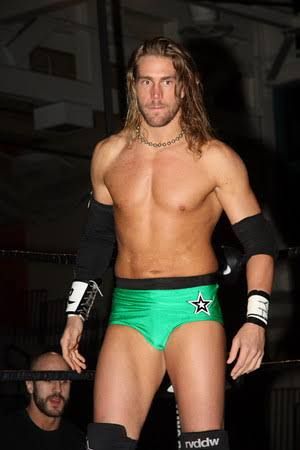
When you start to grow and mature both as a person and as a fan, you start to want to be around and support people like yourself. We make friends who share our interests and our values. We start to watch things with a more critical eye, understanding the finer and more nuanced points of why we enjoy them. It would stand to reason, then, that as I got deeper and deeper into wrestling, I became naturally drawn to people who seemed like they truly loved it the way I do. The kind of wrestlers who are not only fans themselves, but also stewards of the history and lore of their craft. People who eat, sleep, and breathe wrestling so intensely that they could be called a “wrestling genius.”
Chris Hero is a guy that knows ball. He showed up in nearly every major American indie over the 2000s and spent a large portion of that time spreading his knowledge to coworkers and fans across the country. A true student of the game, over the years we saw him wrestle a number of different ways depending on his character and whatever new, interesting thing he had just picked up from watching some old tape. This was a guy who paid attention to every small detail, making sure that the fans who watched closely and obsessed over the small things, like he did, were rewarded for paying attention. He worked at or near the top of every independent promotion worth its salt, raising the bar for in-ring work wherever he went.
I spent my youth involved in the local music scene here in my hometown, and I saw a ton of these types of musicians in my time going to shows. People who seemingly had all of the talent, charisma, and virtuosity of the rock stars headlining arenas and stadiums, playing for 50 people a night. People more interested in playing music for the other nerds in the crowd than for fame and fortune. The kind of people who wear their influences on their sleeve and have a fount of knowledge they’re always happy to share with others, because they see the same passion in you that they feel for the music they play.
Obviously, some guys get into music for money, fame and chicks, and some get into wrestling for the same reasons. Many of the most ardent fans of both however, tend towards the nerdy and obsessive. I know multiple women personally who have been ignored in favor of a guitar, and the trope is laden throughout film and song. I have almost certainly fumbled a time or two in my life by bringing up some obscure wrestler because I couldn’t help myself. Those of us who get really into something can’t help but let it overtake our lives, and music and wrestling are full of them that even I occasionally think it’s a bit much. Metalheads and Joshi fans, i’m looking in your direction.
As I got deeper and deeper into my own wrestling fandom as a young man, Hero stood out to me as somebody who seemingly had that same passion that I saw in my local music scene, but in regards to pro wrestling. He worked his knowledge into his performances in a way that came off as both annoyingly smarmy and effortlessly entertaining.
The character was cocky and braggadocious about his knowledge, often using his superior prowess to frustrate and annoy opponents who couldn’t counter his sneaky tactics. The man himself, however, seemed ready to share those tactics and that knowledge with all who were willing to listen, as evidenced by his time as a trainer, coach, and guest clinician over the years. Starting from an age at which many wrestlers are still working out the basics, he was already sharing his passion and knowledge with the next generation.
He has also been passionate about making sure that the people who did the work get proper credit. Hero’s arsenal of European-influenced moves were openly taken from the “World of Sport” tapes of ’70s and ’80s British wrestling that began circulating in the 2000s. This was new footage to nearly everyone outside of England of a certain age, and Hero seemingly led the charge to study, understand, and incorporate what many of us were seeing for the first time. While not the only evangelist of the style — Bryan Danielson, Colt Cabana, and Zack Sabre Jr. are also notable aficionados — Hero seemed to take special care and love with the greats who originated it. Hero made the technical prowess of Johnny Saint, the clever heel shenanigans of Mick McManus, and brilliant pacing Steve Grey into things that nerdy American teenagers and twenty-somethings would all of a sudden recognize and want to seek out.
Japan and Mexico are easy gateways for an American fan, but British wrestling seemed irreconcilably different to my brain until I started to see the influence show up in the American indies. Wrestlers like Hero, who not only adopted the moves and mannerisms, but was a tireless crusader in interviews for the progenitors to get their roses, made me a better wrestling fan. That’s a rare thing, and it doesn’t happen by accident. It comes from someone who genuinely loves the history and wants you to love it too. Hero was like the record store owner who gave you a black flag record when you came in looking for Green Day. Changing people’s tastes and opinions not only of him, but of the style as a whole one cravate at a time.
Hero was a key player in all of the major independent promotions across the U.S. His time in Chikara saw him as the central figure in the promotion’s early years. His turn on partner Mike Quackenbush to form the original iteration of the Kings of Wrestling with Arik Cannon and Claudio Castagnoli sparked my first real exposure to Chikara. They built years’ worth of stories into a feud centered around a single move, a submission dubbed “The Chikara Special.” This was the kind of micro-detailed storytelling that a nerd like me, who grew up on comic books and anime, could really sink his teeth into.
His time in IWA Mid-South was an example of his ability to adapt to any style or situation. He was forced to work with every type of wrestler under the sun, in a promotion caught between serving its traditional southern fanbase and the audience of hardcore fans purchasing tapes and DVDs to see their favorite young stars putting on high-end matches. Hero could work bloody deathmatches with the Necro Butcher, brawl so hard it seemed like a real fight with Ian Rotten, rile up a classic southern wrestling crowd with Tracy Smothers, and go 90 minutes with CM Punk. It was the perfect balance of entertaining fans like myself, and fans like I used to be. Those small crowds in Kentucky and Indiana would often make up for the lack of size with a vitriol that belonged in the mid south coliseum 20 years prior.
That versatility made him the perfect person to lead the CZW crew that invaded Ring of Honor in 2006. He’d been the Iron Man Champion, he was no stranger to a bloody battle, but he wasn’t necessarily the “face” of CZW the way a more hardcore wrestler might have been. That was the point. Hero had already been fueling the vitriol of a certain set of ROH fans for years before he ever set foot in the company, which made him a far more interesting villain than a pure deathmatch guy would have been.
He was perhaps the most discussed wrestler in the history of the ROH forums, and certainly the most discussed before he ever worked a match for the company. Multiple times a week, seemingly, a thread would pop up asking why Hero wasn’t booked in ROH. The thread would then devolve (as internet conversations often do, this is not a new phenomenon) with reasonable, intelligent, well-thought-out people on one side saying it was preposterous that someone that good wasn’t in the supposedly top indie in the country, while others, who were wrong, dumb, and smelled bad, derided him for looking sloppy, being self-aggrandizing, boring, and not worthy of a promotion like ROH. (Can you guess which side I was on?)
Everybody fancied themselves an expert, and civility was often the last thing on anyone’s mind when the insults over Paul London or Jimmy Jacobs would arise. We were all posting about our favorite company while patiently waiting for our next DVD to arrive (or to show up on the torrent sites…sorry Cary) so we could participate in the conversations the live fans had already seen. Often with only a report to go on, the conversations could get more and more fantastical as time passed. Eventually someone would come in far too aggressively for an internet forum and all hell would break loose, people were called unkind words, bans were handed out and we’d all do it again tomorrow.
When he showed up to face Bryan Danielson for the ROH title, it vindicated what many of us had been clamoring for, but he immediately made even his ardent supporters turn against him when he threatened to win the ROH title and throw it in the trash. When he and his crew of CZW guys started showing up at shows and wreaking havoc across ROH, it turned from a section of fans who didn’t care for Hero into a matter of promotional, stylistic, and almost moral pride. I marvel at how effective the CZW crew were as heels, that I was rooting against a team that included Hero and Super Dragon says everything.
This run would see Hero continue to appear in ROH for years after the conclusion of the feud, winning tag team gold with Claudio, serving as the top star of “Sweet-N-Sour” Inc. managed by the late and incomparable Larry Sweeney, and always being at or near the top of the card. He would go on to spend a few years in the WWE system, imparting his knowledge to others in the developmental system while ostensibly “learning how to wrestle.” He returned to the indies and immediately hopped on with former ROH booker Gabe Sapolsky’s new promotion, Evolve, fitting like a glove. He put on classics with a new crop of outstanding talent like Zack Sabre Jr. and Timothy Thatcher, incorporating that British style with a Japanese influence full of stiff strikes and intricate submission work. The Evolve work, combined with his runs in Pro Wrestling Guerrilla and a litany of other indies, made Hero a name that even the haters had to appreciate in the 2010s. He came back with something to prove and had the best years of his career.
Hero eventually returned to WWE, this time in a role built around using his experience to help new talents get over. He excelled in NXT UK, playing the foil perfectly, an American who knew more and cared more about British wrestling than any of the young punks coming up on the UK scene. There’s a beautiful irony in that. This was a guy who had spent years on the indies telling anyone who would listen about Johnny Saint, dragging American wrestling nerds toward a style they hadn’t considered yet and WWE, of all places, allowed him a character that was essentially built around exactly that. He’d done the work, and the character was the reward. Word spread online among the people who pay attention to these things, and I did something I rarely do anymore, I deliberately sought out WWE content to watch him. He didn’t disappoint. “Budget cuts” (while recording record profits) ended that run in 2020, which felt like a particular waste. He landed on his feet, moving into a producer role in AEW and taking creative control of West Coast Pro, a California indie he occasionally wrestled for as well. Still teaching, still contributing, still in the middle of this beautiful thing we love so much.
Chris Hero is the kind of guy who should have a job in wrestling for as long as he wants one. He has dedicated his life to it and has amassed a wealth of knowledge that anyone lucky enough to share space with him can benefit from. This business, and the world at large, is full of takers, but he has spent most of his life trying to give back to the thing he loves. That’s admirable, and the kind of person I think we should all strive to be. If you love something, your natural tendency should be to care for it, to nurture it, and to ensure its future. Hero has done just that for pro wrestling. History is too easily forgotten. The people who got us here, and how we got here are important parts of the story, and without people who understand just how important, the facts become stories, the stories become fables, and the fables become lost. Through his study, his training, and his work in front of and behind the camera, he has been a true steward of the thing he loves. He gives because he cares, and gets how necessary the preservation of Pro Wrestling is. As someone who is similarly obsessed, I can’t think of a person I’d more want to see employed and around to drop knowledge on us for years to come.
 Raised By the Ring