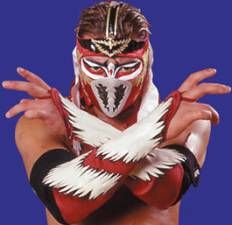
Gather a bunch of wrestling fans together, and invariably the question will come up: “Who is the greatest of all time?” It’s a many-faceted debate that can be argued many ways by many different people. The finer points of the debate will likely be made by me about various acts over the course of this year, but today I’m not concerned with the greatest, because that answer could switch between a few people. I’m also not concerned with my favorite, because once again, it could be any number of people depending on my mood. I want to talk about the coolest wrestler ever: Hayabusa.
I first saw Hayabusa on ECW sometime in 1997 and was immediately captivated. He moved with style and grace, but also a ferocity that felt right at home in the “Land of Extreme.” The genie pants, sash around his waist, his cut, but not quite shredded, physique, and the iconic mask: the Phoenix, risen from the ashes. His nose, mouth, and chin covered in one motif, forming a “beak,” colorful streaks from his cheeks to above his eyes making his “plumage,” and a color-coded headband with a small phoenix in the middle and two strands of fabric hanging at either side, forming his “wings.” When I saw him fly, I could have easily been convinced that he was part bird.
The thing about seeing something like that fleetingly on a TV show you could only see some of the time anyway was akin to finding gold. I would only have vague memories and scraps in my mind until a couple of years later, when the face appeared on a DVD that I immediately had to have. Tokyopop, a company that specialized in distributing Japanese anime and manga to Western audiences, had struck a deal with FMW to distribute some of their highlight matches in the U.S., and I had finally been reunited with this vision of brilliance I had glimpsed years before. This was also around the very beginnings of sites like eBay, which—until copyrights became much more enforced in the early-mid 00s—were a treasure trove of people selling TV shows and other media that weren’t yet available on DVD, which was a fairly new format at the time, or had been altered in some way from their original airing. It was also a place where the “tape traders” of a few years before my time could set up shop and, for a modest price, send you tapes and DVDs of wrestling from around the world. I was 13 and didn’t have access to much of my own money or a credit card, but thankfully my stepfather was both an early adopter of technology and the internet, and most importantly, also a wrestling fan.
I was given a budget and went for the classics: the 1994 Super J-Cup, the 1995 IWA King of the Death Match, and then a carefully selected few FMW shows, mostly figured out from cross-referencing the match lists with the little bits and bobs of information I could find online, but most of all prominently featuring Hayabusa. Some classic battles with Mike Awesome, Masato Tanaka, and Terry Funk. The match that impressed me the most however, and set me down the path of being the lover and appreciator (some would say sicko) of deathmatch wrestling I am today, was the 5/5/95 “No Ropes Barbed Wire Current Mine Explosion Time Bomb Death Match” against FMW’s founder and top star, Atsushi Onita.
Onita was one of the pioneers of the extreme style of wrestling that was FMW’s calling card and was promoting this as his retirement match. This would have been a passing of the torch to Hayabusa as the company’s top star going into the future without Onita at the helm. For those who can’t quite make sense of the title of the match, let’s break it down into pieces. “No ropes barbed wire” means that in place of the traditional ropes of a ring, barbed wire would be strung around the ring instead; this was in turn enclosed by a steel cage. “Current Mine Explosion” refers to the small explosive charges that lined the cage and would explode in a flash of fire and smoke when a man was thrown into them. “Time Bomb” comes from the fact that at the 15-minute mark of the match, large explosions would go off all around the ring, creating danger and chaos for anyone who may be in harm’s way.
I was glued to the screen the first time I popped in the tape and fast-forwarded immediately to the main event. The referee was decked out in a silver bodysuit for his protection—part hazmat, part spaceman. Hayabusa came down looking like a mixture of comic book hero, action star, and otherworldly creature. He motioned to the crowd, and they came alive for the heir apparent to the company. Onita came to the ring with 50,000-plus people screaming his name while a cover of “Wild Thing” by Japanese rock band X blared through the arena. This entrance was so incredibly cool and iconic, that Jon Moxley would openly swaggerjack it years later, and we all still thought it was awesome. This was also my first time being exposed to the production of FMW. The cameras made it look more like a movie than what I was accustomed to in American wrestling.
My hero seemed to have everything going against him, but pro wrestling taught me to always have hope. As the match progressed, Hayabusa spent the first few minutes doing everything he could to avoid the cage and the exploding charges, but after about five minutes that felt like twenty due to the suspense these two were building, they both tumbled into the cage and the first explosion struck. Something so massive that in my mind I swear I felt it in my bedroom that evening, nearly five years after the match had taken place. What I was actually feeling was the culmination of all the things I loved about pro wrestling: the stakes, the drama, the violence, all turned up to a level so high that it bordered on parody, but still felt dark and subversive. If Mick Foley was my deathmatch Tarantino, I would have just gotten a copy of Faces of Death.
The match would continue, with each near miss filling me with fear and dread, and each explosion filling me with excitement and a need to see more. Onita, being the deathmatch legend, was quickly cut and bloodied, but he also seemed to be getting the better of Hayabusa, punishing him with a flurry of offense and attempts to end the match before the timer went off and everybody went up in smoke. Even the referee was pushing Onita to hurry up and get this over with, but a phoenix will always rise from the ashes, sometimes literally.
Despite Onita’s best efforts, a change in momentum caused the clock to continue to tick down. Sirens began to blare in the stadium, signaling the incoming explosion. As the seconds approached and the inevitable arrived, Hayabusa ran toward Onita, who chose to tackle and cover the referee in order to protect him. This both paid off the outfit and actions of the referee during the match, and made Onita “the retiring star” a hero who sacrificed himself to save the innocent referee who was only there to count a pinfall. Hayabusa slammed into the cage as the alarm went off, and all of a sudden the entire arena was littered with popping sounds as the bombs went off. The smoke was so thick that the arena was temporarily in darkness, and the ring area was a haze while the two competitors tried to make sense of what they had just gone through. The two spent what felt like forever on the mat, barely able to gather the strength to continue after such madness. When the smoke cleared, the crowd was living and dying with Onita’s every move, desperate to see their noble hero go out on top. After a few minutes of desperate attempts to top one another, Hayabusa attempted a moonsault—his signature move—from the top of the cage. He missed, and this gave Onita the opportunity to capitalize, and before too much longer, the match was over. My guy lost.
It wasn’t about that, though. I had just found another favorite wrestler to discover and learn all about, in Onita, and more importantly, my mind had been expanded to the idea that pro wrestling could encompass so much more than what I had seen previously. It turned out that Onita wouldn’t even stay retired and would quickly return to the company, but FMW itself moved away from the Onita style of booking that had seen them achieve their highest success. Hayabusa would be pushed as their top star, and while he didn’t ever move business the way his predecessor did, he was able to resonate with FMW’s core fanbase.
More central to my story, however, was the way he resonated with me—and my generation of “smart” fans. The look, the moves, and what today is called “aura” would resonate with so many others in the online wrestling communities of the early 2000s. He was the favorite among so many that you could immediately see his influence on the emerging independent wrestling scene. This would continue throughout wrestling until Falcon Arrows, 450 splashes, and Phoenix Splashes became notable moves used by many of the biggest stars in the world across all the top promotions. He has become one of those wrestlers whose influence is so vast and far-reaching that far too many today only know the homages paid to the man, but not the one who innovated it.
One of the rough things about discovering something late is that you never know how close you are to the end. Roughly 18 months after I had that experience, and before I really had a chance to try and get “current” with the promotion, Hayabusa slipped on the middle rope while attempting a springboard moonsault. A move he had flawlessly executed hundreds of times, this time, the unthinkable happened, and he landed on his head. Two vertebrae were cracked, and just like that, his career was over. He would be paralyzed and wheelchair-bound for the rest of his life.
This clip was one of the very first to go “viral” in wrestling circles, and fairly soon I could view the permanent grounding of the Phoenix in QuickTime. It was one of those videos that felt sickening to watch, but I couldn’t look away from. It was the first time I grappled (pun slightly intended) with the concept of my own responsibility as a fan. Does our desire to see more fantastic and difficult-to-pull-off spots create a world in which people are inherently going to do extremely dangerous things to entertain us? If so, is it our fault in some way when accidents happen and they can no longer perform, let alone live a normal life? It’s a moral and ethical question I couldn’t get a good handle on at 14, and as I approach 40, I’m still not sure I have one.
In 2015, over a dozen years after the injury, Hayabusa was able to walk again with mobility aids, and when he walked into a ring for the first time under his own power in so many years, it filled me with a joy and emotion I couldn’t contain. Tears flowed from my eyes as he stood there, the crowd cheering for him the way they had all those years ago, finally getting to do it on his terms. By 2016, however, he suffered a cerebral hemorrhage and passed away mere months after regaining his ability to walk, at the age of only 47. The wrestling world mourned his passing, and tributes poured in from those affected by him.
I spent the next few days rewatching a bunch of his classics, and it crystallized in my mind that of course I fell in love with a character like this. The outfit, the moves, the mask, and the dedication to the thing he loved most made him the perfect protagonist, and being from a grimy deathmatch promotion in Japan made him the kind of dangerous underground hero that appealed directly to a proto-hipster like myself. I own more Hayabusa merch than any other wrestler by a wide margin, and if and when I ever get a tattoo, it will undoubtedly be his mask. He was the perfect catalyst for a budding smark to find someone to truly obsess over. He might not have been the best worker or drawn the most money, but he was, hands down, the coolest damn pro wrestler to ever exist.
 Raised By the Ring