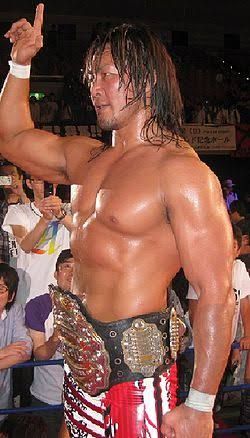
What makes a great babyface? It’s a question with many different answers depending on who you ask. For some, it’s a commitment to doing the right thing, both in the kayfabe context of professional wrestling and outside the ring as well. For others, it’s simply a reaction from the fans. Surely, if the crowd cheers them the most, they must be the most popular and virtuous. Still, others will say it’s all in the work: never bending the rules, selling a beatdown worse than death, always finding a way to inject a glimmer of hope when it seems like all is lost. People will often debate the finer points of the criteria and campaign for their personal choice, which is, I guess, what I’m about to do here for the Ace, Hiroshi Tanahashi.
Ace of the promotion is a title usually applied to the top guy by default. Over the course of his career, Tanahashi has not only embodied the title but made it a central part of his character. He is not just the top guy and face of the New Japan revival and western expansion of the 2010s, he IS New Japan Pro Wrestling. He rose to the top of the company, and throughout the “peak” era of New Japan, he was the mountain that Nakamura, Okada, Naito, Omega, and anybody else that wanted the glory of the IWGP title had to scale. His status as the ace, during one of the most successful runs of the company’s history combined with the rapid expansion of the product into the West, makes Tanahashi as synonymous with New Japan as anyone besides maybe Antonio Inoki.
I had heard the name and seen some of Tanahashi’s work in the mid-2000s, but at the time, NOAH was the promotion of choice for most American puro fans, and I was no exception. In April of 2007, however, I saw him lose the IWGP title to Yuji Nagata in a match that was, to me, at the time much more about Nagata’s refusal to lie down and die against one of the faces of the next generation. Tanahashi impressed me with his ability, especially at taking a beating and garnering sympathy. This was when I started following New Japan a little closer, checking out recommended matches, popping in for big shows, and familiarizing myself with the cast of characters as the company began to crawl out of the hole it had been in for years prior, thanks to what is now just called “Inokiism,” but is a more complicated combination of the rise of MMA, bad business decisions, and internal power struggles and politics. Nagata would be one of a few “old guard” guys that would trade the title with Tanahashi and his rival/contemporary Shunsuke Nakamura.
By the late 2000s, and into the early 2010s, NOAH was starting to decline, with its stars and draws feeling the ravages of age, Kenta Kobashi dealing with cancer, and eventually the death of its founder and top star, Mitsuharu Misawa. By this point, Tanahashi and Nakamura had firmly established themselves as the two top stars of the promotion, with Nakamura receiving the initial push in the mid-00s, and Tanahashi emerging as the guy to carry New Japan into the future. At this point, I was downloading and watching most of the big shows, and the style and in-ring work of Tanahashi were instrumental in keeping me around. This was a time when I was still more interested in the legends I had grown up watching, and as Tanahashi pulled off victories against the Mutohs, Kojimas, Tenzans, and Makabes of the world, I had to admit that I was becoming more and more invested in his rise, and quickly found myself rooting for him more often than not.
At the January 4, 2012 Tokyo Dome show, a couple of things happened that would forever alter the course of Tanahashi, New Japan Pro Wrestling, and myself. The main event saw Tanahashi retain the IWGP Heavyweight Title, the top prize in the promotion. When considering its history, prestige, and lineage, one could argue that it is the top prize in the entire industry. Tanahashi defended it in an excellent match against Minoru Suzuki. He had held the belt since the previous year, after defeating the decorated, multiple-time champion Satoshi Kojima. His victory over Suzuki felt like a declaration, he had finally conquered the ghosts of both Inokiism and the disgruntled “lost generation” whose careers had been hindered by it.
After the match, however, Tanahashi was confronted, not by Nakamura or any of the men who would later be lovingly referred to as the “dads”, but by a young kid who had just returned from an underwhelming excursion in the United States. He had won his match at the Dome, but certainly didn’t impress anyone. Out came Kazuchika Okada. Okada was someone I had been keeping an eye on after seeing him team with Tanahashi a couple of years earlier, when he was still a young lion with black hair, trunks, and boots, a blank canvas being molded into a star. The two teamed up to face a young team I was also very impressed with, despite their early careers: No Limit, consisting of Yujiro Takahashi and Tetsuya Naito. Tanahashi led the young lions through an incredibly entertaining match that made me immediately want to keep an eye on them. A few days later, Okada had his final match before leaving for the U.S. against Tanahashi in a singles match. It felt like those of us paying attention would soon see this matchup again.
Nearly two years later, though, Okada had been wasted in the U.S., his most notable role being that of “Okato,” a racist trope based on a TV show that had been popular 50 years prior. He returned to New Japan earlier in the show with bleached blonde hair, calling himself the “Rainmaker”, the man who makes it rain money. He was supposed to be a young, flashy playboy type, but his return match was nothing special, and it seemed like a massive risk to immediately give a title push to this unproven potential. We all thought he had the tools, but his excursion and return had Okada stock at its lowest point, lower than it would ever be again. In February, Okada shocked the world by defeating Tanahashi for the IWGP title. It was a move that surprised viewers but also felt like a true sea change. This was the start of a new era, with young wrestlers like Okada challenging Tanahashi, who had held the belt for over a year and defeated all challengers. Tanahashi would regain the title by summer, but Okada would win the G1 Climax tournament and challenge Tanahashi in the main event of the January 4, 2013, Tokyo Dome show.
This was one of the most important shows in my life as a wrestling fan, bar none. For the first time ever, fans from outside Japan could stream the show live on a new platform called Ustream. Internet pay-per-views were becoming more common, though with the hiccups and growing pains of any new technology. A number of notable U.S. indies had done them, but this was a chance to watch Japanese wrestling live, as it happened! I plunked down my (I believe) $30, brewed a pot of coffee, and fired up my girlfriend’s laptop around 3 or 4 a.m., headphones plugged in, trying not to wake her up as I finally got to experience this thing that had shaped so much of my fandom in real time with other fans in Japan and around the world, all of us excited to share the experience. Japanese shows would usually appear on download and torrent sites within a few days, a massive step up from waiting on nth-generation VHS tapes like many fans had to do. This time, though, it was happening live in front of our eyes, and the joy of being able to do this at all is a sentiment I’ll always remember when scrolling Twitter that night/morning.
Of course, as cool as the novelty was, if the show didn’t deliver, it would be just that: novelty. Thankfully, the show was amazing, and Tanahashi/Suzuki had what was considered by many people—including some of the most knowledgeable and informed fans, journalists, writers, and podcasters—the Match of the Year. It topped my own personal list, with a couple more Tanahashi matches rounding out my top 10. This show was their chance to show the world what those of us who were making the effort to watch the product knew when we praised it. They knocked it out of the park, and with the success of the show, many more international eyes would soon be on the product.
This was the signal to the people who wanted to watch great matches, and fill out their spreadsheets with star ratings, that New Japan’s horses were becoming amongst the best workers in the business and they were all ready to run. 2010s New Japan would put forth a level of in-ring action rivaled only by the vaunted era of 90s All Japan, but it seemed like New Japan had a seemingly endless pool of all-time greats to pick from. Whenever somebody decided pastures would be greener elsewhere, the company had world champion-level talent ready to hop in and get their chance to shine. This pattern would lead to an explosion in both in-ring quality and insufferable discourse over star ratings. By the 2013 Dome, we had the chance to watch the biggest show of the year live, and I would only miss watching one live ever since (a 2017 bout with pancreatitis where I have vague morphine memories of reading the results, watching it was the first thing I did when I got home from the hospital).
Within a couple of years, Ustream would give way to New Japan World, offering access to nearly all of their shows live, often with English commentary, another factor that undoubtedly helped expose a whole new audience to the product who may have found it inaccessible due to the language barrier. I had always watched shows with Japanese commentary and had no trouble following the stories being told in the ring, but I also fully admit I’m an outlier. Sometimes a familiar voice explaining things can help folks make sense of something, which is why the 2015 Dome seemed like such a big deal.
Tanahashi and Okada had traded victories and titles for a couple of years and were main-eventing the first show to be available on traditional American pay-per-view, including English commentary, provided by Jim Ross, considered by many the greatest commentator of all time and the voice of both WCW in the late 80s/early 90s and the famed “Attitude Era” of the WWF in the late 90s. This would be a chance for those of us who were already converted to evangelize. Prime time, order pizza, grab some beers, and sit down on the couch to watch this thing we keep telling you is so great. While the Shinsuke Nakamura vs Kota Ibushi semi-main event was praised effusively, and 10 years on, seems to be slightly preferred, Tanahashi and Okada had my favorite match of their series (which would eventually end with over a dozen singles matches between them) and my favorite Tanahashi match of all time. They were 3-3-1, with one of Tanahashi’s victories coming in the aforementioned young lion match in 2010, so most saw Okada as the one ahead, especially having won their “last” match. They hadn’t met in over a year after having so many matches when Okada came back, to truly establish him as a top-level guy, so the anticipation was high.
Okada, after another G1 victory, was ready to challenge for the belt, but in October, current champ AJ Styles was defeated by none other than Tanahashi, setting up another match between the two men who were already becoming responsible for the tangible uptick in business domestically and the explosion of popularity internationally. Tanahashi was the face of the company, the top star, the “ace” of the promotion, and Okada was ready to end Tanahashi’s era once and for all and prove himself as the true ace. After another all-time-great match, in which Tanahashi threw himself around and pulled out every ounce of love and energy from the crowd to defeat Okada and prove that he was the number-one guy in the number-one promotion in the world, post-match, he admonished Okada for even thinking he could be on Tanahashi’s level. Okada could do nothing but cry, real human tears of sadness, because not only did he lose, his opponent’s harsh words were right.
Okada would get his revenge and finally ascend to the top of New Japan the next year, but when I think back on the greatest rivalry of all time, the memory that sticks out most will be the Ace celebrating and Okada’s tears. Tanahashi would continue to be a top guy, challenging and holding the IWGP Heavyweight and Intercontinental titles multiple times, but he had also done something exceedingly rare in pro wrestling. He had put over the next generation. This was a man who saw the damage that could be done by people with egos who care more about themselves than the betterment of the scene as a whole. Wrestling is littered with people who held on too long and refused to give up their spots at the top. Tanahashi, meanwhile, did everything in his power to put over not just Okada, but Naito, Ibushi, Omega, and a litany of others who would not have had the chance to showcase their skills or be pushed into positions of prominence without his help.
Now, as Tanahashi steps into his retirement tour in 2025, I find myself thinking back on every moment he’s given us, every sacrifice, every match that felt like a battle for his very soul. As he winds his career down, he has taken on the role of president, using his years of knowledge to bridge the gaps with the corporate types that are signing the checks. Tanahashi seems like the perfect guy for this role, both as a real-life genius when it comes to pro wrestling but also as someone who should be the face of the company. Without him, I don’t know if there is a company. I loved Japanese wrestling before Tanahashi, and I will love it after he is gone. If not for his ability, selflessness, and dedication to New Japan, however, we very likely would not have had the era of wrestling I was most invested in and the memories I made on those late nights, trying not to wake up the rest of the house. I can’t help but think that, like his matches, his legacy isn’t just about the moments he created in the ring. It’s about what he inspired us to become. Because, for me, Hiroshi Tanahashi wasn’t just a wrestler. He was a teacher, a reminder that no matter how hard life hits, you always have the power to rise. GO ACE!
 Raised By the Ring