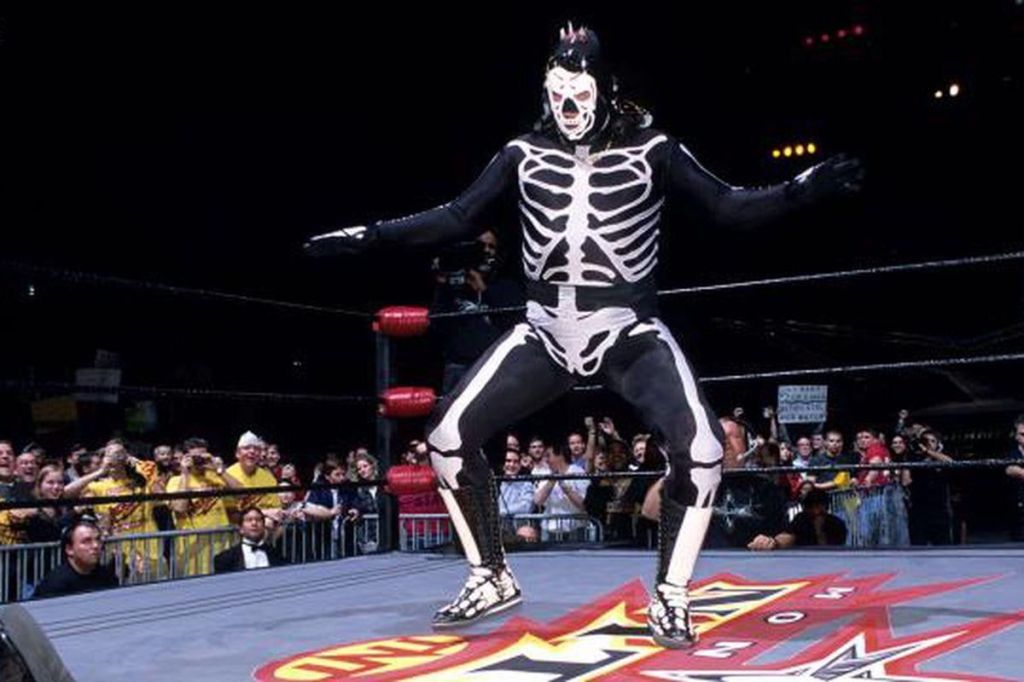
Like many people my age, I have WCW to thank for my introduction to Lucha Libre. The When Worlds Collide show in 1993 was a landmark show in that it let American audiences experience the newly formed and red hot AAA promotion. Once the Monday Nitro era began, our TV screens would be full of a menagerie of characters flying around weekly. The style was entrancing, but even more than that was the wide array of colorful masks and outfits, which made them seem like real-life superheroes. Even as a kid, though, I always preferred the darker side of things, so when La Parka, now known as L.A. Park, showed up on Nitro as a dancing skeleton, I knew this was a guy I was gonna like.
Park has, hands down, the coolest look in the history of pro wrestling. Maybe some of those heavily made-up Joshi heels from the 80s come close, but the skeleton look is in equal measure spooky, silly, and scary. The outfit is made by the performer, however, as we would learn in the early 2000s when legal issues necessitated the slight name change. The charisma of Adolfo Ibarra was what shone under the mask. The dancing skeleton playing air guitar on a chair, to the delight of the thousands of kids in the audience in WCW or in Mexico.
Luchadors have an especially difficult task trying to perform and emote while under a mask. It can be difficult to sell pain or elation without your face visible, but go too far into pantomime and you’ll be criticized for looking silly or over the top. Park has always been able to have a foot in both worlds by being so outwardly goofy during entrances, then becoming a bloodthirsty madman once the bell rings. In contrast to the notions many have about Lucha Libre, Park does very little flying; his best stuff comes when in a fight. Park wrestles like the most dangerous uncle in a bar fight. A sense of realism and hatred permeates his feuds when he’s at his best. While the kids laugh and dance at his antics, his rivals must think this skeleton is death itself, come to collect.
His dance, especially while holding a chair to strum on, was a hit that every boy on the playground did at some point. I used to do it as a kid to celebrate anything, and did until I discovered the RVD point. He was a blast to play as or against in the WCW Revenge video game. I have so many memories of using the reverse taunt to make Dean Malenko, The Giant, Hogan, and everybody else do the La Parka dance. While none of them quite had the swagger of the skeleton, Raven came close. As I grew older and a little more bloodthirsty, the dark juxtaposition of the gimmick grew on me as well. Literally death itself, ready to fight you, make you bleed, and drag you to hell, but also down to jam out and do a silly dance.
Such is his character’s charisma that it famously worked even when he wasn’t the one behind the suit and mask. On the July 7, 1997 edition of Monday Nitro, we were shown a video package highlighting LA Parka, most notably his proficiency with a chair. He then went on to have a match against Randy Savage, a name so notable that even my mom knows him. This would normally be a quick squash match, but Park moved out of the way when Savage climbed the ropes to hit his signature diving elbow. Out of nowhere, Park hit Savage with a… diamond cutter? And pinned him! “La Parka” then took off his mask to reveal he was in fact Diamond Dallas Page, who had been feuding with Savage.
While technically the match was worked by Page, Park deserves some credit as the fount of charisma who DDP knew the fans would be receptive to. He wasn’t as high on the pecking order as Rey Mysterio, Psicosis, or Juventud Guerrera, but his dancing, antics, and iconic look made the audience receptive to the idea of him beating Savage, even if it wasn’t actually him.
I remember the feeling of pure shock when “La Parka” stood up, but the diamond cutter was the tip off. I briefly did the kind of mental logic leaps that only a kid would make. DDP must have paid LA Parka to hit his move and send a message, but the reveal made me leap off the couch in excitement. Of course it was DDP, it all made sense to me finally. Still, I liked the feeling of the world where La Parka just beat Savage straight up, even if if only lasted seconds, it’s one that has resonated for years.
DDP would only occupy the gimmick for a night. When he returned to Mexico after the end of WCW, Park found that he had spawned imitators in his absence. His home promotion of AAA had been promoting a man as “La Parka Jr.” for a number of years, but when Park jumped to rival CMLL in 2003, AAA dropped the Jr. and he began wrestling simply as “La Parka.”
This was technically legal because the owner of the promotion owned the rights to the gimmick, so it was within their rights to put whoever they wanted into the suit and say, “dance, skeleton, dance.” This was when the name changed to “La Authentica Parka” or L.A. Park full time. I have tried to use the Park name as often as possible to make sure people know I am referring to the original.
This was unfathomable to me, as my only frame of reference to something like this was the brief period in the mid 90s where Rick Bogner and Glen Jacobs (the future Mayor Kane) played “Razor Ramon” and “Diesel” in a sadly pathetic attempt to get back at Scott Hall and Kevin Nash for leaving. In my eyes, if you were just another guy playing the same character, you were a worthless copy, with the exception of Davey Richards playing the Dynamite Kid.
This new La Parka just stepped right into the role, and for a generation of fans younger than me, he IS the real La Parka. They say time heals all wounds, and by 2010 Park was ready to come back to AAA and make some money. Time heals, but a big payday certainly helps speed that process up, and Park is a man who is about his money first and foremost.
In true pro wrestling fashion, Park made sure to get paid twice to give up the name for good. At Triplemania (AAA’s big show of the year) in June 2010, Park won over La Parka in a match for the rights to the name. The match, however, was marred with all kinds of illegal moves and interference. So much so that the commission that oversees Mexican wrestling overturned the result and ruled that both men must keep their respective names. This is an actual governmental organization ruling on a pro wrestling match, which sounds crazy, but also shows what a cluster it was. On July 4, Parka would defeat Park in a rematch, finally putting an end to the feud and the confusion over the name.
Park would become one of many legends in the 2010s who used their final years of ability to cash as many checks as possible. It’s an unfortunate necessity in a business without pensions or retirement plans. As the body breaks down, the aches worsen, the medical bills rise, and the earning window narrows. For many, wrestling is all they’ve ever known. There is no safety net waiting on the other side.
Park always understood what his moneymaker was. It was so good that two versions had been able to thrive in the same ecosystem. It was the gimmick.
In lucha, there is one last payday everyone knows is coming: the mask. As contemporaries slowed down, many cashed it in, losing a mask match and standing bare-faced before a packed arena for one final emotional payoff. It is ritual, tradition, and commerce wrapped into one. Sometimes it’s legacy. Sometimes it’s survival. And sometimes, unless you’re Dr. Wagner Jr. and look like a sexy grandpa, it’s simply the end of the line.
In the late 2010s, Park found a new dance partner, a young, hot, fiery wrestler who had a reputation and a temper. Rush came into Park’s life at the twilight of his career and ignited a rivalry that took them all over Mexico. The two engaged in singles and tag matches all over Mexico, with their names littering indy posters across the country and drawing big crowds almost every time. Rush works with an intensity and edge that makes you question if he knows this is supposed to be a work. He also has a history of blowups with other wrestlers, management, and fans that makes you question if he knows this is supposed to be a work. Park, however, is always happy to dish out the punishment.
These two would meet in various combinations over a dozen times with their singles matches always standing out as bloody violent affairs. They would brutalize one another all over the arena, much to the delight of the always raucous crowds. Rush tearing at Park’s mask, making sure the crowd could see him bloodying their idol. Park never says die, and pays Rush back in spades. The bouts would always feature plenty of shenanigans and interference in order to protect everyone no matter who actually won or lost the fall. This was made easier when the allies of the two men would join in for tag team and trios matches and someone other than the main two could take the loss.
As his body starts to go and his gut expands, he has evolved into more of a bar-room brawler. Your drunk uncle who can take your best shot and give one right back to you. This has made the feud between the two a massively heated affair anytime they cross paths. They go at each other with a viciousness and ferocity that makes fans go rabid with excitement. With the popularity of the feud, most people assumed that they were heading to a big Mask vs Hair match at some point that unfortunately never came.
Park always held out, still working to this day with his mask. Maybe after losing the battle over the name, he decided he would never lose the face. He was the originator. Maybe he wants to be buried in it. The kids who watched him in 1997 grow up and have kids of their own now, they pass those memories down. The mask makes him ageless. To an 11-year-old, he’s still a superhero, to a 40-year-old, he’s still the same as they remember. That’s the power of it, the gimmick outlives the body.
In lucha, great masks rarely disappear. They get handed down, revived, rebooted. The character survives even when the man underneath can’t. Just ask the 47 Huracan Ramirezes. When you originate something like that, no matter who imitates or profits from it, they can’t take that away from you. You’re the first, and while you won’t be the last, you can decide how you get to tell your story.
Maybe he’s holding out for a number no promoter can meet. Maybe it’s pride. Maybe it’s just good business. Whatever the reason, as long as the mask stays on, L.A. Park never has to become just another aging wrestler on a poster. He may be slower now. He may be bigger. The matches may not be what they once were. But when that music hits and a skeleton starts dancing with a chair, it can still be 1997 for a few minutes. As long as that mask never comes off, in some small way, it always will be.
 Raised By the Ring